
When working on piping systems, especially in industrial projects, one question comes up quite often:
Do we really need welding, or is there a simpler way to connect pipes?
That’s exactly where threaded flanges come in.

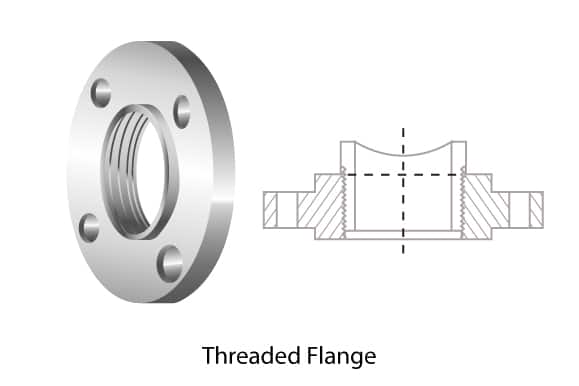
A threaded flange (also called a screwed flange) is designed with internal threads, allowing it to be directly screwed onto a pipe with matching external threads.
Unlike welded flanges, it does not require any welding during installation, which makes it a practical solution in many real-world situations.
From a structural point of view, the connection relies on thread engagement rather than fusion, so installation is faster and easier.
In theory, welded connections are stronger. But in practice, threaded flanges still have their place.
Here’s why many projects still choose them:
In some industries, especially where hot work is restricted, threaded flanges are often the only viable option.
Threaded flanges are usually used in:
They are most commonly applied in small diameter pipelines (≤ 4 inch) and lower pressure classes.
Threaded flanges are convenient, but they are not suitable for every situation.
From an engineering perspective, there are a few limitations:
Because of these factors, welded flanges are usually preferred in critical systems.
In real projects, the decision is usually straightforward:
Many pipeline systems actually use both, depending on different sections.
One mistake many buyers make is focusing only on “type”.
But in reality, these factors matter just as much:
Getting these right early can save a lot of trouble later.
If you're sourcing threaded flanges for a project and not fully sure about the specifications, it's always better to confirm before ordering.
You can check detailed specs here:
👉 https://www.senruipipe.com/products/threaded-flange
Or just send your requirements, such as:
We’ll help you match the right type and give you a quick quote.
Threaded flanges are not a replacement for welded flanges, but they are a smart solution in the right situations.
Choosing the right connection method is less about “which is better” and more about what your project actually needs.


